WORKERS
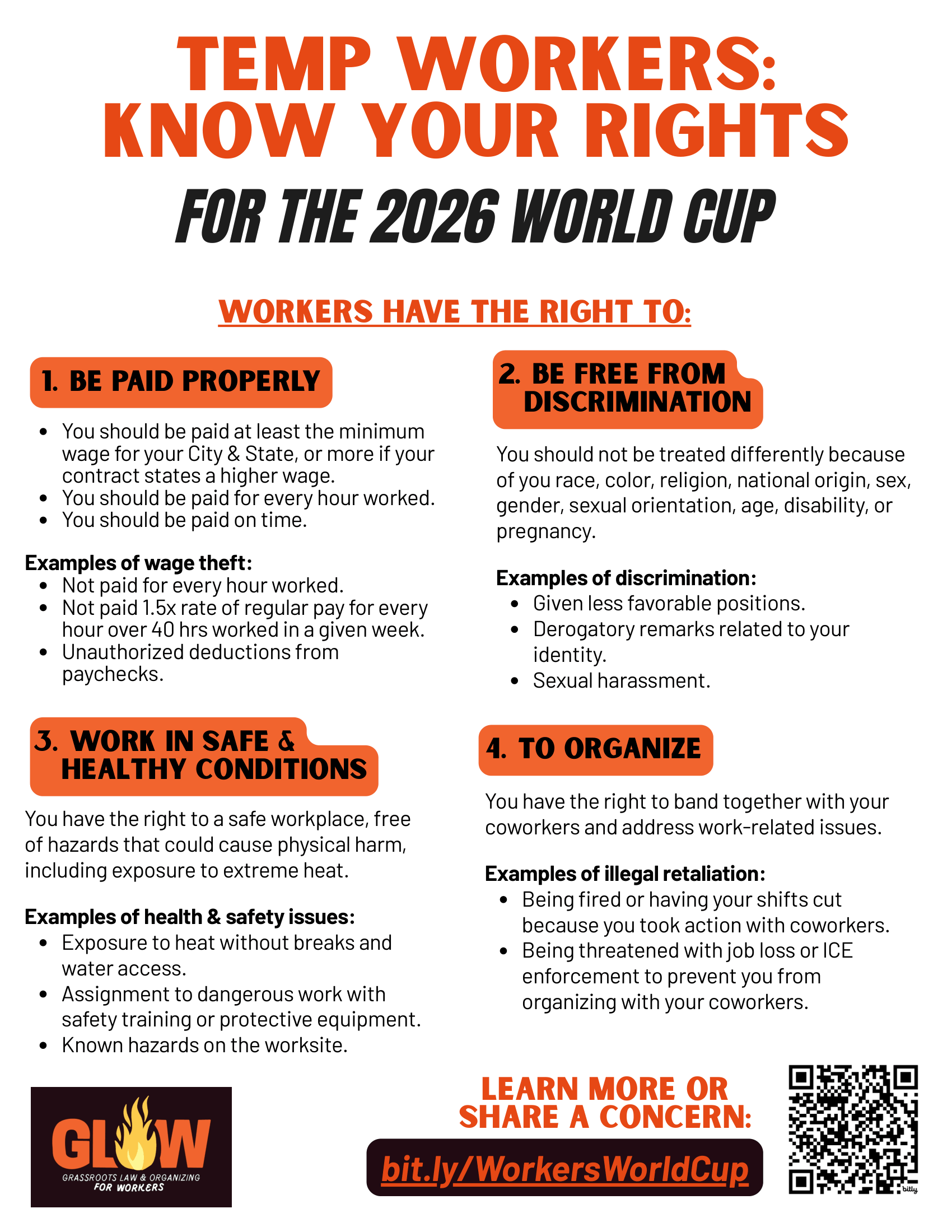
Know Your Workplace Rights
U.S. - NATIONAL RESOURCES
Union Facts: The Value of Collective Voice
Contact a Union Organizer
(If you already have a union in your workplace, we encourage you to reach out to your local union directly.)
Your Rights to Unionize
Employees covered by the National Labor Relations Act are afforded certain rights to join together to improve their wages and working conditions, with or without a union. Here is some information on your rights, provided by the National Labor Relations Board, which oversees this process for most workers.
Union Activity
Employees have the right to attempt to form a union where none currently exists.
Examples of employee rights include:
-
Forming, or attempting to form, a union in your workplace;
-
Joining a union, whether the union is recognized by your employer or not;
-
Assisting a union in organizing your fellow employees;
-
Refusing to do any or all of these things, and
-
Having the right to be fairly represented by a union.
Employees who are not represented by a union also have rights under the NLRA. The National Labor Relations Board protects the rights of employees to engage in “concerted activity,” which is when two or more employees take action for their mutual aid or protection regarding terms and conditions of employment. A single employee also may engage in protected concerted activity if he or she is acting on the authority of other employees, bringing group complaints to the employer’s attention, trying to induce group action, or seeking to prepare for group action.
A few examples of protected concerted activities are:
-
Two or more employees addressing their employer about improving their pay.
-
Two or more employees discussing work-related issues beyond pay, such as safety concerns, with each other.
-
An employee speaking to an employer on behalf of one or more co-workers about improving workplace conditions.
Who Is Covered by the NLRA?
Most employees in the private sector are covered by the NLRA. However, the act specifically excludes individuals who are:
-
Employed by federal, state, or local government
-
Employed as agricultural laborers
-
Employed in the domestic service of any person or family in a home
-
Employed by a parent or spouse
-
Employed as an independent contractor
-
Employed as a supervisor (supervisors who have been discriminated against for refusing to violate the NLRA may be covered)
-
Employed by an employer subject to the Railway Labor Act, such as railroads and airlines
-
Employed by any other person who is not an employer as defined in the NLRA.
-
People with this employment status may have rights to unionize through other labor laws.
-
More information on your rights can be found on the NLRB website.
4 Steps to Form a Union
When you and your co-workers come together to form a union, you get the right to negotiate with your employer over wages, benefits and working conditions.
No matter what the industry you are in, or the labor law that covers it, the process for forming a union is similar.
-
Get together with your co-workers who may share a common interest in organizing a union.
-
Talk to a union organizer in order to strategize and to learn the next steps.
-
Talk to your co-workers to build support for the union.
-
Show that support through an election or a card-check once you have a strong majority.
Once your union is official, you’ll choose your leaders and negotiate a contract. The process is democratic, and the more inclusive you can be, the stronger your union will be.
HEAT STRESS
The World Cup will be held during the height of summer in North America, where temperatures in host cities frequently exceed 82°F or 28°C. The AFL-CIO has developed a heat safety checklist for workers, venues, and contractors to decrease the risk of heat stress during the World Cup.
BEST PRACTICES TO PROTECT STADIUM WORKERS FROM HEAT DURING THE 2026 FIFA WORLD CUP
A union guide for worker heat prevention and protection
Core Principles
A strong and comprehensive heat protection program must be:
-
Proactive and preventive, not reactive
-
Cover all workers throughout indoor and outdoor areas of the stadiums
-
Designed for both indoor and outdoor work for stadiums
-
Assigned a designated person in charge of the program and communicated to workers and supervisors
-
Easily understood (appropriate languages)
-
Updated regularly
Heat Safety Checklist
Workers' Rights to:
-
A safe workplace, free from recognized heat hazards
-
Know and understand heat hazards and symptoms
-
Report unsafe working conditions and illnesses/injuries without retaliation
-
Stop work when experiencing symptoms of heat illness
Written Heat Safety Plan
Every venue and contractor should have a written heat illness prevention plan that includes:
-
Ongoing temperature and humidity monitoring
-
Heat exposure prevention controls (barriers, ventilation, etc.)
-
Water, rest and shade policies
-
Acclimatization protocols
-
Interactive training
-
Emergency procedures and communication plans
-
Worker complaint procedures and anti-retaliation protections
Paid Breaks Provided for Water, Rest & Shade
-
Water for workers must always be free, cooled, clean and easily accessible/close to work areas, and workers need permission to drink water whenever needed
-
Shade for workers must always be provided in a cool area (i.e., not a hot car or structure) and with enough space so that workers can spread out and cool off
-
Breaks for workers must always be paid, mandatory, without retaliation
Acclimatization Protocols
New workers are at the highest risk for heat fatality.
-
Gradually increase workloads
-
Can acclimatize workers during training
-
Closely monitor new workers or those who haven’t worked in the past week
Worker Training
Training should occur well before the tournament begins, be language appropriate and include:
-
Signs and symptoms of heat illness and heat stroke emergencies
-
Hydration practices
-
Workers’ rights
-
Emergency procedures
-
Reporting procedures
-
Individual risk factors
Emergency Response
Every venue should have:
-
Immediate medical response procedures and supplies for rapid cooling (ice baths, etc.)
-
Designated and trained onsite contacts and responders
-
Clear emergency communication plans internally and externally
-
Plans for emergency vehicle access and transportation
Additional Heat Triggers
Use a heat index or WBGT of 80°F to trigger:
-
Additional water
-
Additional shade
-
Paid, mandatory breaks
Use a heat index or WBGT of 90°F to trigger:
-
More frequent paid, mandatory breaks
-
Reduced workloads and work pace
-
Additional staffing
-
Buddy systems
-
Increased monitoring
-
Stop work authority for workers
More resources
Working Safely in Heat: OSHA fact sheet on working safely in heat
The following resources are intended to help union members know their rights and ensure they are prepared to defend themselves and the immigrant members of their families and communities in the event of workplace or community raids.
-
AFL-CIO Worker and Family Readiness Checklist in English and Spanish
-
AFL-CIO KYR Cards in 32 languages
AFL-CIO Immigration Resources For Workers
IMMIGRATION
Tbd
-
tbd
-
.
Tbd
-
tbd
-
.
Wage and hour violations / misclassification
-
For addressing wage theft concerns:
-
Workers Defense Project, Employment Legal Services
-
Dallas Phone: 469-657-3928
-
-
Equal Justice Center (no office in NTX):
-
Texas Workforce Commission
-
Discrimination and/or harassment
Health and safety
-
Texas does not have a state level OSHA plan. Private sector workers are covered by Federal OSHA.
-
Heat Protection: There is no state-mandated occupational heat protection.
Employment rights help in Spanish
https://espanol.equaljusticecenter.org/legal-help/
Employment rights:
https://www.equaljusticecenter.org/legal-help/basic-emp-rights.html
Worker organizing
-
Information about organizing a union: https://texasaflcio.org/issues/organizing
-
Form a Union: https://texasaflcio.org/form-union
Tbd
-
tbd
-
.
Wage and hour violations / misclassification
-
Missouri Department of Labor, minimum wage complaint process: https://labor.mo.gov/dls/minimum-wage/file-complaint
Discrimination and/or harassment
-
Missouri Department of Labor, filing a complaint of discrimination: https://labor.mo.gov/mohumanrights/file-complaint
Health and safety
-
Missouri does not have a state level Occupational Safety and Health Administration (OSHA) plan. Private sector workers are covered by federal OSHA rules.
-
Heat Protection
-
There is no state-mandated occupational heat protection.
-
Worker organizing
Contact a Union Organizer: https://aflcio.org/formaunion/contact
Tbd
-
tbd
-
.
Tbd
-
tbd
-
.
Wage and hour violations/misclassification
-
NJ Department of Labor
-
NJ DOL Page for World Cup Workers: https://www.nj.gov/labor/myworkrights/worker-protections/temp_workers/worldcup.shtml
-
Information for workers on misclassification:
-
-
NY Department of Labor, https://dol.ny.gov/labor-standards-complaint-process
-
Minimum Wage and Hour Rights
-
New York State Department of Labor
-
-
-
dol.ny.gov (search “labor standards”) | 888-469-7365
-
File a Claim on this page: Unpaid/Withheld Wages and Wage Supplements
-
Prevailing Wages
-
Contractors must meet higher minimum pay and benefits requirements for workers under certain public work contracts and certain private projects receiving public funding or tax benefits
-
NYC Comptroller
-
-
comptroller.nyc.gov (search “prevailing wage”) 212-669-3916
-
You can file a complaint with the New York City Comptroller’s Office by filling out an online complaint form.
-
Paid Family Leave
-
Your employer must provide up to 12 weeks of job-protected paid time off.
-
New York State Paid Family Leave
-
-
paidfamilyleave.ny.gov | 844-337-6303
-
Family and Medical Leave Act
-
Employers with 50 or more employees must provide eligible employees up to 12 weeks of unpaid family and medical leave
-
U.S. Department of Labor
-
-
dol.gov | 866-487-9243
-
Workers Compensation and Disability Benefits
-
New York State Workers’ Compensation Board
-
-
https://www.wcb.ny.gov/content/main/Workers/file-claim.jsp | 877-632-4996
Discrimination and/or harassment
-
Employers in NYC must provide reasonable accommodations - which can include a change to a work schedule, disability, pregnancy, religious observance, and status as victim of domestic violence. To report a reasonable accommodation complaint:
-
NYC Commission on Human Rights
-
https://www.nyc.gov/site/cchr/enforcement/complaint-process.page | 311 (say Discrimination) or 212-416-0197
-
-
New York State Division of Human Rights
-
https://dhr.ny.gov/report | 800-392-3644
-
-
U.S. Equal Employment Opportunity Commission
-
-
Equal Pay. You have a right to equal pay for equal work and to discuss pay with your coworkers. To file a complaint contact:
-
New York State Attorney General
-
https://formsnym.ag.ny.gov/OAGOnlineSubmissionForm/faces/OAGLBHome;jsessionid=bFYKDjKOogsAdv3txTb_wZ8qAhvo8wn-d3yUo2reaulMDKknUpP4!-693319502 | 800-771-7755, 212-416-8700 or TaskForceforWorkersEquality@ag.ny.go
-
-
Health and safety
-
New Jersey has a state level OSHA plan that covers only public sector workers, private sector workers are covered by Federal OSHA
-
New York has a state level OSHA plan that covers only public sector workers, private sector workers are covered by Federal OSHA
-
Heat Protection
-
New Jersey has no state-mandated occupational heat protection.
-
New York has no state-mandated occupational heat protection.
-
-
Health Insurance
-
If your employer offers health insurance, you may have the right to continue health benefits when you lose coverage or change jobs.
-
U.S. Department of Labor
-
Worker organizing
-
New Jersey
-
New York
-
National Relations Board
-
New York City Central Labor Council: https://nycclc.org/
-
The New York City Central Labor Council (NYCCLC) is a non-profit labor membership organization devoted to supporting, advancing and advocating for the working people of New York City. As the nation's largest regional labor federation, the NYCCLC brings together 300 local unions from every trade, occupation, public and private sector of the New York economy. We represent more than 1 million workers, including teachers, truck drivers, operating engineers, nurses, construction workers, hospitality workers, electricians, firefighters, retail workers, janitors, train operators, bakers, and many more who are the backbone of today’s workforce.
-
Contact: info@nycclc.org | (212) 604-9552
-
A resource for union members and organizers: https://toolsfororganizers.org/
-
-
New York State AFL-CIO: https://nysaflcio.org/
-
The New York State AFL-CIO is a federation of 3,000 affiliated public sector, private sector, and building trades unions throughout the state, representing 2.5 million members, retirees and their families. Working with our affiliates, area labor federations, central labor councils, and community allies, we fight to improve the lives and working conditions of all hard working New Yorkers. Through grassroots advocacy, political and legislative action, policy analysis, and coordinated communications, the New York State AFL-CIO is a force for progressive change.
-
New York City Office
-
-
-
50 Broadway, 35th Floor
New York, NY 10004
Phone: 212-777-6040
Fax: 212-777-8422
-
Albany Office
100 South Swan Street
Albany, NY 12210
Phone: 518-436-8516
Fax: 518-436-8470
Wage and hour violations / misclassification
-
NJ Department of Labor
-
NJ DOL Page for World Cup Workers: https://www.nj.gov/labor/myworkrights/worker-protections/temp_workers/worldcup.shtml
-
Information for workers on misclassification:
-
-
NY Department of Labor, https://dol.ny.gov/labor-standards-complaint-process
-
Minimum Wage and Hour Rights
-
New York State Department of Labor
-
-
-
dol.ny.gov (search “labor standards”) | 888-469-7365
-
File a Claim on this page: Unpaid/Withheld Wages and Wage Supplements
-
Prevailing Wages
-
Contractors must meet higher minimum pay and benefits requirements for workers under certain public work contracts and certain private projects receiving public funding or tax benefits
-
NYC Comptroller
-
-
comptroller.nyc.gov (search “prevailing wage”) 212-669-3916
-
You can file a complaint with the New York City Comptroller’s Office by filling out an online complaint form.
-
Paid Family Leave
-
Your employer must provide up to 12 weeks of job-protected paid time off.
-
New York State Paid Family Leave
-
-
paidfamilyleave.ny.gov | 844-337-6303
-
Family and Medical Leave Act
-
Employers with 50 or more employees must provide eligible employees up to 12 weeks of unpaid family and medical leave
-
U.S. Department of Labor
-
-
dol.gov | 866-487-9243
-
Workers Compensation and Disability Benefits
-
New York State Workers’ Compensation Board
-
-
https://www.wcb.ny.gov/content/main/Workers/file-claim.jsp | 877-632-4996
Discrimination and/or harassment
-
Employers in NYC must provide reasonable accommodations - which can include a change to a work schedule, disability, pregnancy, religious observance, and status as victim of domestic violence. To report a reasonable accommodation complaint:
-
NYC Commission on Human Rights
-
https://www.nyc.gov/site/cchr/enforcement/complaint-process.page | 311 (say Discrimination) or 212-416-0197
-
-
New York State Division of Human Rights
-
https://dhr.ny.gov/report | 800-392-3644
-
-
U.S. Equal Employment Opportunity Commission
-
-
Equal Pay. You have a right to equal pay for equal work and to discuss pay with your coworkers. To file a complaint contact:
-
New York State Attorney General
-
https://formsnym.ag.ny.gov/OAGOnlineSubmissionForm/faces/OAGLBHome;jsessionid=bFYKDjKOogsAdv3txTb_wZ8qAhvo8wn-d3yUo2reaulMDKknUpP4!-693319502 | 800-771-7755, 212-416-8700 or TaskForceforWorkersEquality@ag.ny.go
-
-
Health and safety
-
New Jersey has a state level OSHA plan that covers only public sector workers, private sector workers are covered by Federal OSHA
-
New York has a state level OSHA plan that covers only public sector workers, private sector workers are covered by Federal OSHA
-
Heat Protection
-
New Jersey has no state-mandated occupational heat protection.
-
New York has no state-mandated occupational heat protection.
-
-
Health Insurance
-
If your employer offers health insurance, you may have the right to continue health benefits when you lose coverage or change jobs.
-
U.S. Department of Labor
-
Worker organizing
-
New Jersey
-
New York
-
National Relations Board
-
New York City Central Labor Council: https://nycclc.org/
-
The New York City Central Labor Council (NYCCLC) is a non-profit labor membership organization devoted to supporting, advancing and advocating for the working people of New York City. As the nation's largest regional labor federation, the NYCCLC brings together 300 local unions from every trade, occupation, public and private sector of the New York economy. We represent more than 1 million workers, including teachers, truck drivers, operating engineers, nurses, construction workers, hospitality workers, electricians, firefighters, retail workers, janitors, train operators, bakers, and many more who are the backbone of today’s workforce.
-
Contact: info@nycclc.org | (212) 604-9552
-
A resource for union members and organizers: https://toolsfororganizers.org/
-
-
New York State AFL-CIO: https://nysaflcio.org/
-
The New York State AFL-CIO is a federation of 3,000 affiliated public sector, private sector, and building trades unions throughout the state, representing 2.5 million members, retirees and their families. Working with our affiliates, area labor federations, central labor councils, and community allies, we fight to improve the lives and working conditions of all hard working New Yorkers. Through grassroots advocacy, political and legislative action, policy analysis, and coordinated communications, the New York State AFL-CIO is a force for progressive change.
-
New York City Office
-
-
-
50 Broadway, 35th Floor
New York, NY 10004
Phone: 212-777-6040
Fax: 212-777-8422
-
Albany Office
100 South Swan Street
Albany, NY 12210
Phone: 518-436-8516
Fax: 518-436-8470
See generally: https://www.phila.gov/departments/department-of-labor/
Wage and hour violations/misclassification
-
Report a Fair Workweek Violation: https://www.phila.gov/services/working-jobs/worker-protections/wage-protections/report-a-fair-workweek-violation/
-
Report wage theft violation: https://www.phila.gov/services/working-jobs/worker-protections/wage-protections/report-wage-theft/
-
Report paid or unpaid leave violations: https://www.phila.gov/services/working-jobs/worker-protections/paid-or-unpaid-leave/
Discrimination and/or harassment
-
File an employment discrimination complaint: https://www.phila.gov/services/working-jobs/worker-protections/discrimination-and-harassment/file-a-complaint-about-employment-discrimination/
-
File a sexual harassment complaint: https://www.phila.gov/services/working-jobs/worker-protections/discrimination-and-harassment/file-a-sexual-harassment-complaint/
-
File an Equal Employment Opportunity (EEO) complaint: https://www.phila.gov/services/working-jobs/worker-protections/discrimination-and-harassment/file-an-equal-employment-opportunity-eeo-complaint/
Health and safety
-
Pennsylvania does not have a state level Occupational Safety and Health Administration (OSHA) plan. Private sector workers are covered by federal OSHA rules.
-
PhilaPOSH is an organization made up of unions, health, and legal professionals working together since 1975 for a safe and protected workplace as well as for the rights of injured workers. Organized in 1975, the Philadelphia Area Project on Occupational Safety and Health (PhilaPOSH) was the second organization formed in the United States that focused on health and safety issues faced by workers and their unions.
-
Over the past 45 years, they have provided assistance to hundreds of unions and thousands of workers, both union and non-union. They offer trainings on a wide range of topics related to worker health and safety, including OSHA 10 Hour, OSHA 30 Hour, and OSHA Fall Prevention trainings.
-
Heat Protection
-
Pennsylvania has no state-mandated occupational heat protections.
-
Worker organizing
-
Philadelphia Council AFL-CIO: https://philaflcio.org/
-
The Philadelphia Council AFL-CIO builds worker power across the city by building and supporting a strong network of local unions. They can help you get connected to local unions, coalitional partners, and in forming your own union!
-
Connect with a union organizer: https://actionnetwork.org/forms/organize-a-union-today
Wage and hour violations / misclassification
Reporting Violations and Learning Your Rights At Work:
Washington State Department of Labor and Industries (L&I) protects workers from unpaid wages, missing meal and rest breaks, and child labor violations caused by unlawful business practices. You can file a claim using this link.
Seattle Office of Labor Standards investigates claims to enforce Seattle ordinances. You can file a complaint, call (206) 256-5297 with interpretation services, or visit their office:
810 3rd Avenue, Suite 375
Seattle, WA 98104-1627
Hours: Monday thru Friday 9am to 4pm
For more information about your rights as a worker in Seattle or broader Washington, visit Fair Work Center, a non profit organization that supports workers across different industries. You can reach them at help@fairworkcenter.org.
Discrimination and/or harassment
Reporting Discrimination:
If you think you have experienced discrimination or harassment please contact the Seattle Office for Civil Rights (SOCR) at (206) 684-4500, email them at discrimination@seattle.gov or visit the SOCR website by clicking here.
Health and safety
-
The Washington State Department of Labor & Industries administers a Washington State Division of Occupational Safety and Health Plan (WADOSH). https://www.lni.wa.gov/safety-health/. WADOSH covers both public and private sector workers.
-
Heat Protection
-
WA has an outdoor heat standard, including requirements for: Temperature trigger of 80°F, water, rest, shade, training, paid rest break, and acclimation requirements.
-
-
If further treatment is necessary after getting first aid from your employer, go to the emergency room or health-care provider of your choice and tell them you were injured at work. This page from Washington State Department of Labor and Industries (L&I) helps you know what to expect from your provider and how to tell your employer. If the employer is self-insured, you might need to file a claim here.
Worker organizing
-
Reach out to an organizer about forming a union at your workplace here. MLK Labor is a central labor council in King County representing over 150 unions and upwards of 200,000 union workers.
Additional Resources
Visit the Seattle Office of Immigrant and Refugee Affairs (OIRA) to find out about services available for immigrants and refugees. Click here for the OIRA resource page.
Tbd
-
tbd
-
.
Tbd
-
tbd
-
.
Tbd
-
tbd
-
.